


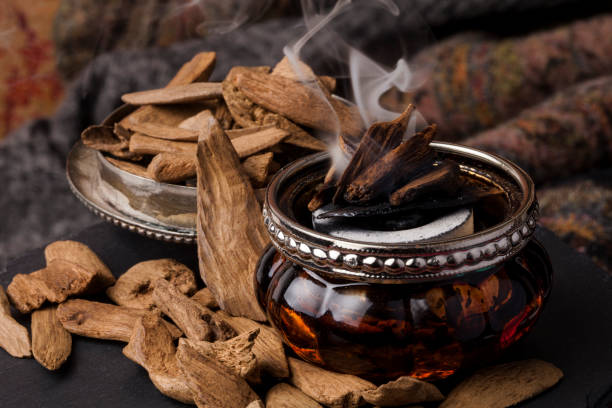
Meditation is often described as the practice of quieting the mind, but creating the right environment can make it easier to transition from a busy day into a more focused state. Agarwood incense for meditation offers a simple sensory ritual: light an agarwood incense stick, allow its warm woody aroma to gradually fill the space, and use the scent as a consistent cue for relaxation and mindfulness.
For centuries, agarwood from Aquilaria species has been valued in traditional medicine, religious practices, and cultural rituals. Modern pharmacological research has also investigated agarwood extracts and essential oil for their effects on the central nervous system, including sedative-related activity in preclinical studies.
The result is an interesting connection between traditional incense practice and modern mindfulness routines: the scent itself can become an olfactory anchor that helps define the beginning of a meditation, yoga, or bedtime ritual.
Why Is Agarwood Suitable for Meditation?
A successful meditation environment does not necessarily require expensive equipment or complicated preparation. What matters is creating conditions that encourage consistency and reduce distractions.
Agarwood has a naturally complex aromatic profile, with sesquiterpenes and other characteristic compounds contributing to its distinctive fragrance. Reviews of Aquilaria research have identified a range of biological activities associated with agarwood and its constituents, including effects involving the central nervous system.
A Woody Aroma That Creates a Calm Atmosphere
Unlike sharp or highly stimulating fragrances, high-quality agarwood is often appreciated for its deep, warm, woody and resinous character.
When used as an agarwood incense stick, the fragrance develops gradually rather than appearing all at once. This slow progression can complement practices where the user intentionally reduces external stimulation.
The purpose is not to make the incense a substitute for meditation itself. Instead, the aroma can become part of the environment in which meditation takes place.
Turning Scent Into an Olfactory Anchor
One useful concept in mindfulness practice is the use of a consistent sensory cue.
For example, someone may always:
- Turn off unnecessary notifications.
- Dim the lights.
- Sit on the meditation cushion.
- Light one agarwood incense stick.
- Take several slow breaths.
- Begin the meditation session.
After repeating the same sequence, the aroma can become associated with the beginning of the practice.
In this sense, agarwood incense for meditation works less like a “focus drug” and more like a ritual signal—a recognizable sensory transition from everyday activity to intentional attention.
What Does Research Say About Agarwood and Relaxation?
Scientific research provides an interesting background for the traditional use of agarwood, but the evidence needs to be interpreted carefully.
A study published in Journal of Ethnopharmacology reviewed the traditional uses, phytochemistry and pharmacological activities of Aquilaria species and reported effects involving the central nervous system among the areas investigated.
Earlier experimental research in mice found that certain agarwood extracts produced effects consistent with central nervous system depressant activity, including reduced spontaneous movement and increased sleeping time under the study conditions.
Research has also investigated agarwood essential oil specifically. In an animal study, agarwood essential oil showed sedative-hypnotic effects, with results suggesting involvement of GABA-A receptor-related mechanisms.
A later review focusing on agarwood essential oil discussed its potential relevance to anxiety, insomnia and other mental-health-related applications, while also noting limitations in the existing research.
What This Means for Meditation
These findings help explain why agarwood has traditionally been associated with calmness and tranquility.
However, it is important to distinguish between preclinical research on extracts or essential oils and the experience of burning an incense stick.
Current research does not establish that simply burning agarwood incense produces a clinically proven sedative or therapeutic effect in humans. Instead, the research provides scientific context for agarwood’s traditional reputation for calming and relaxing applications.
For everyday users, the more practical role of incense may therefore be supporting a consistent sensory environment for relaxation and mindfulness.
Agarwood Incense for Yoga and Mindful Movement
Meditation is not the only setting where agarwood incense can become part of a daily wellness ritual.
Yoga combines physical movement, breathing and attention. For many practitioners, the environment before and during a session can influence how easily they transition away from everyday distractions.
Before a Yoga Session
Lighting an agarwood incense stick several minutes before yoga can establish a clear beginning to the practice.
The ritual can be especially useful when practicing at home, where the same room may normally be associated with work, entertainment, meals or household activities.
A familiar fragrance can help visually and mentally redefine the space as a temporary yoga environment.
During Breath-Focused Practice
Some yoga and mindfulness exercises emphasize slow breathing and awareness of physical sensations.
A subtle, familiar scent can become another point of sensory awareness. Instead of trying to eliminate every sensory experience, the practitioner can simply notice the fragrance and then return attention to breathing or movement.
This makes agarwood incense for yoga particularly relevant to people who enjoy incorporating natural sensory elements into their practice.
Agarwood Incense as a Bedtime Ritual
The same principle can be applied at night.
Modern routines often end with a rapid transition from work, social media, entertainment or screen time directly into bed. A short ritual can create a clearer boundary between active time and rest.
A simple bedtime sequence could look like this:
Step 1: Reduce Stimulation
Put away unnecessary devices and reduce bright lighting.
Step 2: Light the Agarwood Incense
Place one incense stick in a stable, heat-resistant holder and allow the aroma to gradually develop.
Step 3: Slow Down
Spend several minutes reading, stretching, breathing or sitting quietly rather than immediately checking another screen.
Step 4: Associate the Aroma With Rest
Repeating the same sequence can make the scent part of a familiar bedtime cue.
The objective is not to claim that agarwood incense treats insomnia. Rather, it is to use agarwood incense as part of a calming bedtime ritual that separates active daytime behavior from nighttime relaxation.
How to Use Agarwood Incense for Relaxation and Mindfulness
The effectiveness of a ritual often comes from simplicity and consistency.
For a meditation or mindfulness routine, users can try the following approach:
| Ritual | Purpose |
|---|---|
| Light one incense stick | Creates a clear beginning |
| Sit comfortably | Reduces physical distraction |
| Take slow breaths | Encourages attention to the present moment |
| Notice the agarwood aroma | Provides an olfactory focus point |
| Return attention to breathing | Builds mindfulness |
| End with a few quiet minutes | Creates a gradual transition |
The fragrance does not have to remain the main focus throughout the entire session.
Instead, the user can notice it briefly, allow the sensory experience to settle into the background, and return attention to the chosen meditation object.
Why Scent Can Strengthen a Daily Mindfulness Habit
One of the biggest challenges with meditation is consistency.
Someone may understand the benefits of mindfulness but still struggle to practice every day because there is no clear transition between ordinary activities and meditation.
A physical ritual can help solve this behavioral problem.
Lighting the same agarwood incense stick at approximately the same time each day creates a repeatable sequence:
light → smell → breathe → settle → focus
Over time, the sequence itself can become meaningful.
This is why the concept of an olfactory anchor is particularly interesting. The fragrance does not need to “force” concentration. Instead, it provides a familiar environmental signal that tells the mind: this is the time to slow down and pay attention.
Choosing Agarwood Incense for Meditation
Not every incense product is identical, so buyers interested in mindfulness should consider several practical factors.
Aroma Profile
A meditation incense should have an aroma that is comfortable rather than excessively strong. Agarwood is often selected for its rich, woody and resinous fragrance.
Burning Characteristics
A slow and relatively consistent burn can be more suitable for meditation and bedtime rituals because the fragrance develops gradually.
Ingredient Transparency
For consumers who use incense regularly, understanding the materials used in the incense is important. Clear product information helps buyers make informed choices about the fragrance experience.
Sustainable Agarwood Sourcing
Sustainability is particularly important for agarwood because natural Aquilaria resources have faced significant pressure. Scientific reviews emphasize the importance of sustainable cultivation and forestry practices for the future use of agarwood.
For brands and wholesale buyers, responsible sourcing is therefore not simply an environmental consideration. It can also become an important part of product quality and brand storytelling.
A Note on Incense Smoke and Indoor Use
Relaxation should not be separated from responsible use.
Burning incense produces smoke and particulate matter, and research has raised concerns about indoor air pollution associated with incense combustion. Reviews have discussed potential adverse effects from incense smoke, while research specifically on agarwood has also noted that the safety of smoke from agarwood incense requires further investigation.
For this reason, incense should be burned in a suitable holder and in a reasonably ventilated space. Users who are particularly sensitive to smoke should consider whether burning incense is appropriate for them.
This distinction is important: the potential calming character of agarwood fragrance should not be interpreted as evidence that inhaling incense smoke is inherently beneficial to health.
From Incense Product to Mindfulness Experience
The appeal of agarwood incense extends beyond fragrance alone.
For meditation practitioners, yoga users and people creating a bedtime routine, the product can become part of a broader sensory experience:
- Agarwood aroma creates a distinctive atmosphere.
- Slow burning provides a natural sense of time passing.
- Repeated use creates a recognizable ritual.
- Mindful breathing brings attention back to the present.
- A consistent environment helps separate relaxation from everyday activity.
This is also why the phrase “promote relaxation and mindfulness” can be more meaningful when understood as an experience rather than a medical promise.
The incense does not need to perform the entire job. It simply needs to become one reliable part of the ritual.
Why Agarwood Incense Works as a “Focus Switch”
The idea of an incense “focus switch” is ultimately about association.
A person lights an agarwood incense stick. The familiar woody aroma begins to spread. The lights are lowered. The phone is put aside. Breathing becomes slower. The person sits quietly.
After repeated practice, these actions can form a recognizable routine.
That makes agarwood incense for meditation an accessible way to introduce more intention into everyday moments. It combines the sensory appeal of natural fragrance with the behavioral power of a repeated ritual.
For meditation, yoga or a quiet evening at home, one small incense stick can mark the transition from doing to being—not as a medical treatment, but as a simple sensory cue for relaxation, attention and mindfulness.