


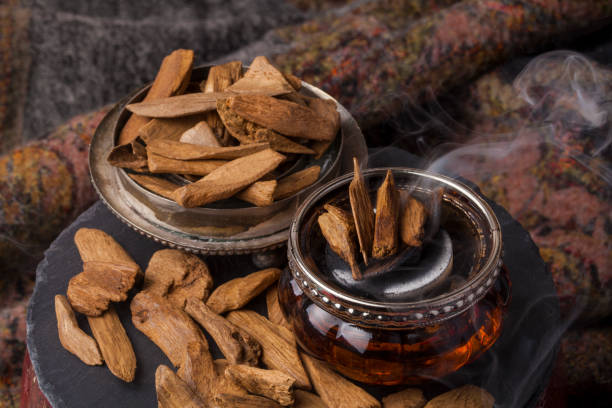
Agarwood has long held a distinctive place in Traditional Chinese Medicine (TCM) and traditional incense culture. Unlike ordinary aromatic materials used mainly for fragrance, agarwood has traditionally been valued for its relationship with Qi regulation, warming, and the concept of “Na Qi” (纳气). In TCM, agarwood is described as slightly warm and pungent-bitter, with traditional channel associations involving the spleen, stomach, and kidney. Its classical functions include promoting the movement of Qi, warming the middle, stopping vomiting, and “Na Qi” to relieve wheezing or shortness of breath. 👉 https://www.crescentoud.com/product/agarwood-incense-carrying-the-millennium-incense-culture-of-china/
Among these traditional descriptions, Na Qi (纳气) is perhaps the most intriguing for modern readers.
It does not simply mean “breathing better.” Rather, it refers to the traditional TCM idea that the Kidney helps receive and anchor Qi, allowing inhalation to be deeper and more rooted. This provides a very different way of understanding why agarwood has traditionally been associated with respiratory comfort and whole-body Qi regulation.
Important note: The concepts of Qi, Kidney Qi, and Na Qi belong to the theoretical framework of Traditional Chinese Medicine. They should not be interpreted as modern medical diagnoses or as evidence that agarwood incense can treat asthma, COPD, or other respiratory diseases.
What Does “Na Qi” Mean in Traditional Chinese Medicine?
The Chinese term 纳气 (Na Qi) can be translated approximately as “receiving” or “anchoring Qi.”
In TCM theory, the Lung governs respiration, but the Kidney is traditionally described as helping the body “receive” Qi from the breath. When this function is considered insufficient, classical TCM descriptions may include symptoms such as shallow breathing, shortness of breath, or difficulty inhaling deeply.
This is why traditional descriptions of agarwood include “纳气平喘” (Na Qi and relieve wheezing) rather than simply describing it as a fragrant material.
Lung and Kidney: A Different View of Breathing
From the TCM perspective, breathing is not considered an isolated function of the lungs.
The traditional relationship can be simplified as:
Lung → governs the movement of breath
Kidney → receives and anchors Qi
Lung + Kidney → support a complete breathing process
This theory is especially important in traditional discussions of chronic respiratory weakness and “Kidney Qi deficiency.” Research discussing TCM approaches to stable COPD also notes the traditional concept of a Lung-Kidney relationship, while emphasizing that evidence for kidney-tonifying interventions has limitations and requires further high-quality research.
This distinction helps explain why Na Qi is more specific than simply saying that an aromatic substance has a pleasant smell.
Why Is Agarwood Traditionally Associated With “Na Qi”?
Agarwood is unusual among aromatic materials because its traditional value extends beyond fragrance.
Classical Chinese medical literature has described agarwood with functions including moving Qi, warming the middle, and Na Qi. Modern references to the Chinese Pharmacopoeia similarly describe agarwood as slightly warm, pungent and bitter, associated with the spleen, stomach and kidney channels, with traditional indications including kidney-deficiency-related rebellious Qi and wheezing.
1. Agarwood Is Traditionally Considered an Aromatic Qi-Regulating Material
In TCM, “Qi” is a broader functional concept than simply air or oxygen.
Qi regulation refers to the movement, direction and balance of Qi within the body’s functional systems.
Agarwood’s traditional role is therefore often described through terms such as:
- Qi regulation
- Qi descent
- warming
- harmonizing
- Na Qi
This is fundamentally different from the modern concept of an air freshener, whose primary purpose is generally to alter or mask environmental odors.
2. Its Traditional Kidney Association Makes “Na Qi” Especially Relevant
Agarwood is traditionally associated with the Kidney channel as well as the spleen and stomach.
This matters because the Kidney’s ability to “receive Qi” is a central concept behind Na Qi.
In classical TCM thinking, therefore, agarwood’s relationship with breathing is not simply:
pleasant aroma → pleasant feeling
It is more closely understood as:
aromatic quality → Qi movement → downward/anchoring function → Na Qi
This is a traditional theoretical framework rather than a modern physiological mechanism.
From “Breathing” to “Conscious Breathing”
This is where the traditional idea becomes particularly interesting for modern lifestyles.
Many people spend long periods sitting at desks, looking at screens, driving, or working under sustained mental pressure. Without claiming that these experiences constitute “Kidney Qi deficiency,” people may notice that their breathing becomes habitual and shallow when they are tense or highly focused.
A quiet incense ritual can create an opportunity to consciously slow down.
Instead of simply smelling agarwood, a person may sit comfortably, notice the fragrance, and allow the breath to become slower and more deliberate.
The value here does not need to be framed as a medical treatment.
It can be understood as a mindful breathing ritual inspired by traditional incense culture.
Agarwood Incense and the Practice of Intentional Breathing
When agarwood incense is used appropriately, the ritual can involve three simple steps:
Step 1: Pause
Move away from screens and other immediate distractions.
Step 2: Notice the Aroma
Rather than taking repeated deep inhalations of smoke, simply notice the natural fragrance in the surrounding space.
Step 3: Let the Breath Become Natural
Allow the breathing rhythm to settle without forcing deeper or longer breaths.
This distinction is important.
The purpose is not to inhale more smoke.
For indoor incense use, adequate ventilation and responsible burning practices remain important. People with respiratory sensitivities should be particularly cautious around smoke and should not use incense as a substitute for medical care.
Agarwood Is More Than an Air Freshener
This is one of the most useful distinctions for consumers discovering agarwood today.
An ordinary air freshener is primarily designed to create a particular environmental scent. Agarwood, by contrast, comes with a much deeper cultural and traditional context.
| Air Freshener | Agarwood Incense |
|---|---|
| Primarily changes room fragrance | Fragrance plus traditional incense culture |
| Often designed for strong scent release | Often valued for subtle aromatic development |
| Focuses mainly on environmental odor | Associated with traditional Qi and wellness concepts |
| Usually a functional household product | Also connected with meditation and ritual |
| Modern fragrance experience | Centuries of Chinese incense and TCM tradition |
The distinction is therefore not simply about how strong the fragrance is.
It is about why the fragrance is being experienced.
For consumers interested in traditional wellness, agarwood can represent a more intentional approach to creating a quiet sensory environment.
What Makes Agarwood Different From Other Aromatic Materials?
Agarwood’s traditional reputation is closely connected with the resinous aromatic material formed in certain Aquilaria trees after injury and subsequent resin formation.
This creates a material with a complex aromatic profile rather than a single straightforward fragrance.
Its cultural history is also unusually extensive. Historical sources describe agarwood as an important material in Chinese incense culture, while traditional medical texts recorded its medicinal use.
A Fragrance With Cultural Depth
The significance of agarwood comes from the combination of:
- natural resinous fragrance
- traditional Chinese incense culture
- historical medicinal use
- meditation and contemplative practices
- distinctive aromatic character
This is why premium agarwood is often appreciated differently from synthetic room fragrances.
The experience is not only about making a room smell pleasant.
It is about creating an atmosphere with cultural, sensory and ritual meaning.
How “Na Qi” Can Be Reinterpreted for Modern Wellness
Modern consumers do not necessarily need to accept every traditional medical theory literally to appreciate the wisdom behind the practice.
The concept of Na Qi can be approached as an invitation to pay attention to breathing.
In TCM, the traditional framework connects the Lung, Kidney and Qi. In a modern lifestyle context, the practical takeaway can be much simpler:
Slow down. Notice your breath. Create a quiet environment. Let breathing become conscious rather than automatic.
Agarwood incense can become part of that ritual.
This does not mean agarwood “repairs the kidneys” or medically treats breathing disorders. Rather, it shows how an ancient concept can inspire a contemporary mindful breathing and relaxation ritual.
Agarwood, Meditation, and a Quiet Home Environment
The traditional use of incense has long been associated with contemplation and ritual.
Today, agarwood can naturally fit into several quiet-space scenarios:
Meditation
A subtle agarwood fragrance can help establish a consistent sensory cue for meditation or quiet reflection.
Reading
A calm fragrance environment can make reading or personal reflection feel more intentional.
Evening Wind-Down
Some people use incense as part of a transition from work time to personal time.
Tea and Traditional Rituals
Agarwood can also complement tea, calligraphy, meditation and other traditional cultural practices.
In each case, the important concept is ritual rather than medical treatment.
What “Na Qi” Does Not Mean
Because TCM terminology can easily be misunderstood in modern marketing, several distinctions are important.
It Does Not Mean Agarwood Treats Asthma
“Na Qi Ping Chuan” is a traditional TCM functional description. It should not be converted into a claim that agarwood treats asthma, COPD, or other respiratory diseases.
It Does Not Mean More Smoke Is Better
Burning more incense or inhaling smoke more deeply does not make the traditional concept more effective.
The intended experience is the fragrance and ritual environment—not deliberate smoke inhalation.
It Does Not Replace Medical Care
People experiencing persistent shortness of breath, wheezing, chest pain, or other respiratory symptoms should seek appropriate medical evaluation.
Modern research on TCM approaches to respiratory disease continues to develop, and systematic reviews have noted both potential findings and limitations in the existing evidence.
Why This Ancient Idea Still Matters
The most interesting part of agarwood in Traditional Chinese Medicine may not be whether modern science can directly translate every traditional concept.
It is that the concept of Na Qi encourages people to think about breathing as something worthy of attention.
Modern life often rewards speed:
faster work → faster communication → faster consumption → faster rest
Traditional incense culture offers almost the opposite rhythm:
pause → fragrance → breath → awareness
In this sense, agarwood can serve as a bridge between traditional Chinese wisdom and contemporary wellness rituals.
Its value does not have to depend on making exaggerated medical claims.
The fragrance itself, the ritual of burning incense, and the deliberate pause it creates can all contribute to a more mindful environment.
Choosing Agarwood for a More Meaningful Incense Experience
For consumers exploring natural agarwood incense, several factors are worth considering.
Aroma Character
Agarwood can present complex resinous, woody and sometimes sweet or balsamic aromatic notes. Personal preference matters more than simply choosing the strongest fragrance.
Source and Material
Agarwood quality can vary according to species, origin, resin formation and processing. Responsible sourcing and transparent product information are therefore important considerations.
Intended Use
A product intended for meditation may have different preferences from one intended for occasional home fragrance or traditional ceremonial use.
Burning Environment
Use incense in a suitable space with appropriate ventilation. The goal is to appreciate the aroma comfortably rather than maximize smoke exposure.
The Deeper Meaning of Agarwood “Na Qi”
“Na Qi” is one of the most distinctive traditional ideas associated with agarwood.
Within the framework of Traditional Chinese Medicine, it reflects the relationship between the Lung, Kidney, and Qi, and explains why agarwood has traditionally been described as having a “Na Qi and relieve wheezing” function.
For modern consumers, this ancient idea can be interpreted more practically—not as a promise to cure respiratory disease, but as an invitation to reconnect with something surprisingly easy to overlook:
the breath.
When agarwood is used as part of a quiet incense ritual, the experience can move beyond simply making a room smell good. It can become a moment to pause, breathe naturally, and create a calmer sensory environment.
That is perhaps the most meaningful way to rediscover the traditional wisdom of agarwood today.